

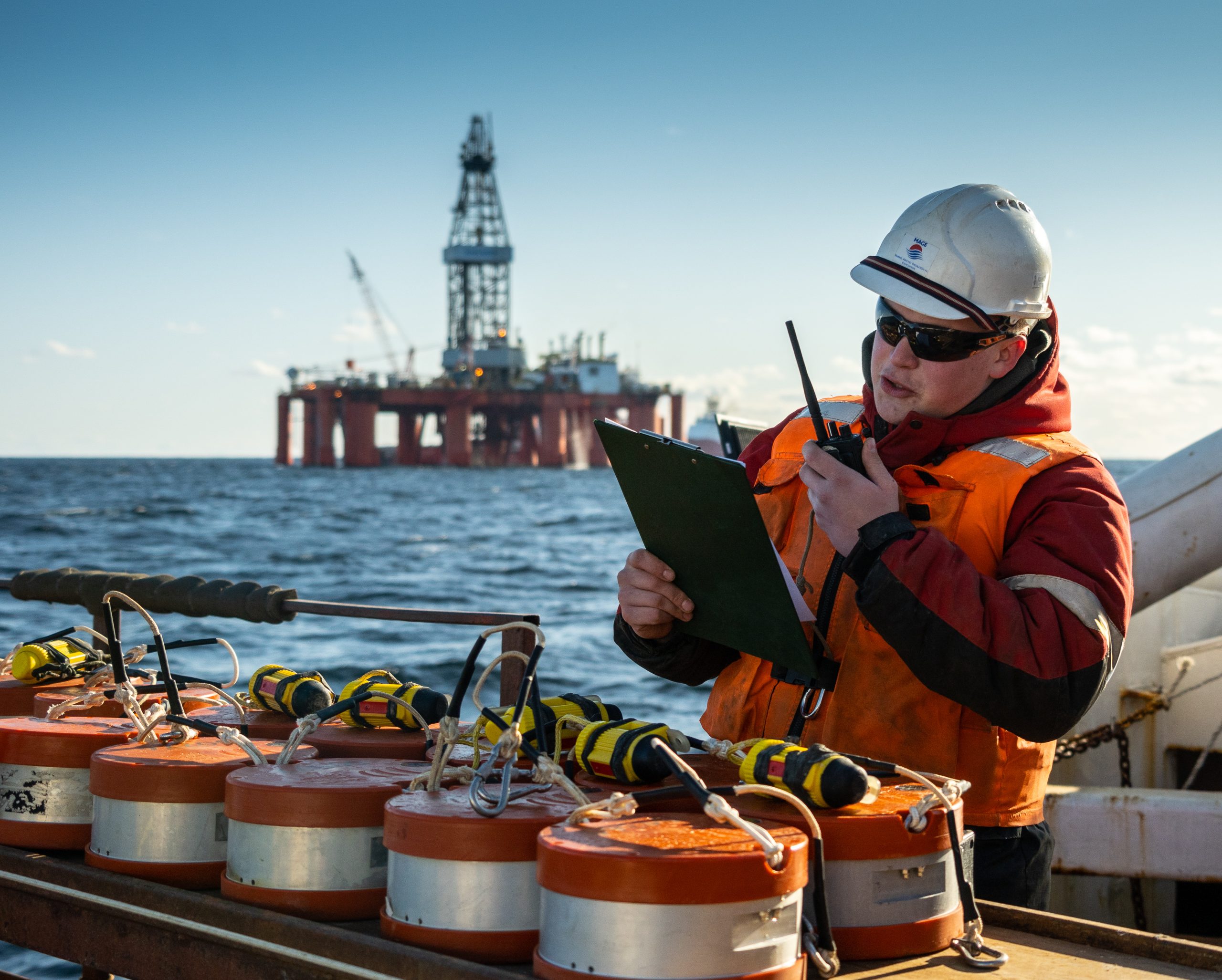
The most innovative type of seismic survey 4D/4C, using the Russian-made “CRAB” and “CORALL” seismic data recording systems, provides a comprehensive approach to solving geological problems of any complexity at sea and in the transit zone. The method of recording four components of the seismic wave field has undeniable advantages over other methods. The seismic data obtained via this method provides a detailed assessment of the geological environment, which significantly increases the accuracy of reserve estimation. The use of bottom nodes enables the monitoring of existing fields to optimize their operation.
One of the company's most significant achievements was the launch of 4D/4C seismic survey in the Sea of Okhotsk using the “CRAB” marine seismic exploration system based on fully domestic autonomous bottom recorders. Additionally, the Russian ultra-short-range hydroacoustic navigation system “PIKET” was introduced for positioning the seismic recorders. These works are aimed at creating a basic network of high-quality seismic data that allows for tracking changes in the position of interfluid contacts during subsequent 4D seismic surveys, providing effective control over the development of oil and gas fields.
By the end of 2024, the total volume of 3D and 4D works performed with bottom nodes is about 2,000 square kilometers, whereas the volume of 2D works is 2,500 kilometers.
By the end of 2025, the total volume of 3D and 4D works performed with bottom nodes is about 2,400 square kilometers, whereas the volume of 2D works is 2,500 kilometers.
Today JSC “MAGE” provides a full cycle of production of ocean bottom nodes. This implies the original design, upgrading, as well as optimization of operation and minimization of failures, the assembly and implementation of new versions of the station in the company's production projects. The uniqueness of such vertical integration lies in the fact that not only the concept of the station is developed, but also its assembly and testing, calibration and preparation for production work is carried out, which highlights the high level of technological competence of the company.